Word Association Tiles
Echidna GamesWord
4.9299.00 Reviews
- Version
- 1.19.00
- Installs
- 100.00K
- Age Rating
- Everyone
Screenshots
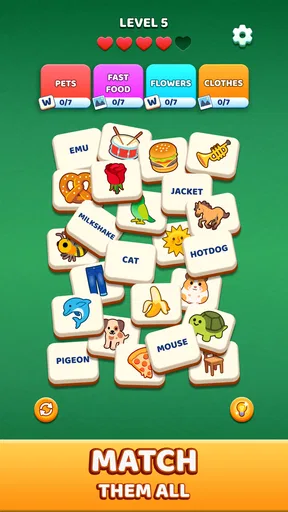
Our Review of Word Association Tiles
 Analysis by Appyee
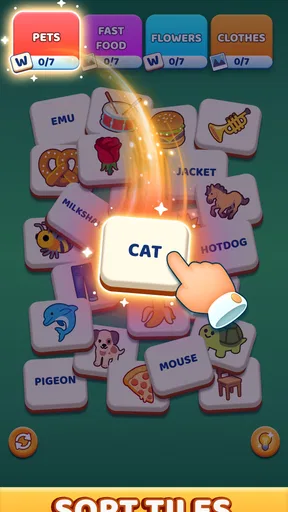
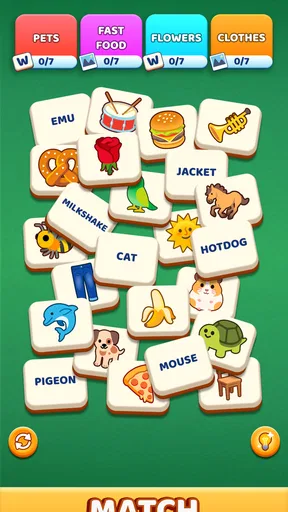
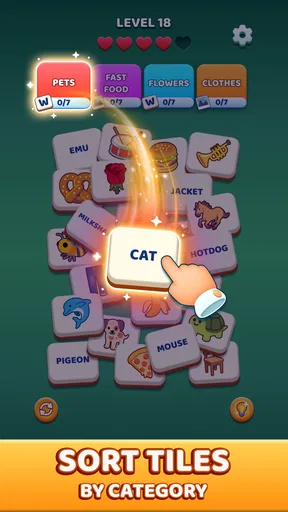
I reached for Word Association Tiles expecting a light word game, but its appeal is more specific than that. The central task is to sort words and pictures into related categories, so each round asks me to recognize connections rather than simply find letters or guess a definition. That makes it a calm choice for short breaks, especially when I want something mentally active without the pressure of a countdown or a competitive score chase.
It is a free word game from Echidna Games, rated for Everyone, and it runs on devices using Android 7.1 or later. The game has built a 4.8 average from around 4,600 ratings and has passed 100,000 installs, which gives it a reassuring level of real-world use without making it feel like an overcrowded social platform. I found the strongest reason to try it is not the size of that audience, but the way its word-and-picture format sits between a traditional puzzle and a visual sorting exercise.
How to decide whether this word puzzle fits you
The first question is what kind of thinking you enjoy. If you like grouping ideas, spotting links between apparently unrelated items, and testing whether a category is broad or precise, this game has a clear advantage. It rewards flexible association. A word may belong with another item because of meaning, use, type, or a familiar everyday connection, while a picture can make the same decision more intuitive for players who do not want a wall of text.
If you prefer crossword-style clues, anagrams, spelling battles, or dictionary-heavy challenges, the experience may feel less exact. Those games usually tell you what kind of answer is required. Here, the interesting part is often deciding what the puzzle setter considers a meaningful group. That creates a gentler rhythm, but it also means a wrong choice can occasionally feel like a disagreement about interpretation rather than a failure of vocabulary.
I would also consider who will use it. The Everyone age rating makes it suitable for a broad household audience, and the mixture of pictures and words gives younger players a way into the format. Adults can still find it worthwhile because the challenge is not limited to recognizing simple objects. The more useful test is whether the player enjoys discussing why two items belong together. In a family setting, that conversation can be part of the fun rather than an interruption.
For a quick daily routine, the game works best when treated as a small mental reset. I can open it while waiting for an appointment, play a little, and stop without needing to remember a complicated storyline. That is a meaningful advantage over larger puzzle games that demand a longer session or make me feel I am abandoning a campaign halfway through.
The way the sorting format changes the experience
Sorting tiles sounds simple, but it creates a useful second layer of thought. I am not only asking what an item means; I am comparing it with everything else currently visible. A picture can initially seem obvious, then become ambiguous when a stronger category appears elsewhere. I found it helpful to hold back from committing immediately and first scan the whole group for repeated themes.
My most reliable approach was to begin with the clearest pair or cluster, then use the remaining tiles to test whether that assumption actually holds. This prevents one attractive connection from pulling the rest of the board into an awkward category. It is a small habit, but it makes the game feel more deliberate and reduces the frustration of making a quick guess based on the first association that comes to mind.
The visual element also changes how I play compared with a conventional word-only puzzle. Pictures reduce the need to translate every clue into a definition, which is helpful when I am tired or when another player has a different reading level. At the same time, images can introduce their own ambiguity: an object may represent what it is, what it does, or an idea commonly linked to it. I enjoy that extra flexibility, though players who want one strictly technical answer may prefer a more formal word game.
The key decision is whether you enjoy interpreting relationships more than producing exact answers. That distinction matters. This is not simply a vocabulary test with decorative artwork. Its best moments come from comparing possible categories and noticing the connection that ties a group together.
Where it wins against familiar word-game alternatives
Compared with a crossword, this game asks less of me in terms of spelling and clue conventions. I do not need to know whether an answer should be entered in the singular, or whether a clue is using an obscure abbreviation. The emphasis is on recognition and categorization, so it feels more approachable when I want a puzzle that starts quickly.
Compared with an anagram game, it is less focused on letter manipulation. Players who love rearranging letters may miss that satisfying moment of discovering a hidden word. In return, the tile format brings more variety to the reasoning. I am considering meaning, visual identity, and context rather than repeatedly searching for a new order of the same letters.
It also occupies a different space from word-association party games. Those games often depend on other people, timed turns, or deliberately funny answers. Word Association Tiles is better suited to solo concentration or a quiet shared session where two people can debate a category. I would choose it when I want a peaceful puzzle, not when I am trying to create a noisy group activity.
Against large brain-training collections, its narrower focus is both a strength and a limitation. There is less distraction from unrelated mini-games, which makes the experience easier to understand and return to. On the other hand, anyone looking for arithmetic, memory, reaction, and logic exercises in one place will probably find a broader puzzle suite more useful.
Practical ways I would use it
One realistic use is a short break during a busy day. Instead of opening a feed and losing track of time, I can work through a few sorting decisions, put the phone down, and return to what I was doing. The lack of a demanding narrative makes that easy. It feels like a small reset rather than a commitment to a long game.
It can also work as a low-pressure family activity. An adult and child can look at the same tiles and explain their reasoning, even when they disagree. That is particularly useful because the pictures offer a shared starting point, while the words invite conversation. I would not present it as a formal educational lesson, but it can encourage vocabulary, classification, and verbal explanation without feeling like homework.
A third use is as a warm-up before more demanding word work. I found that sorting categories makes me pay attention to nuance: whether two items are truly members of the same group or merely connected by a loose association. That mindset can be useful before writing, studying, or solving a harder puzzle. The game is not a replacement for those activities, but it provides a gentle way to get my attention focused.
For players who share a device, I recommend taking turns explaining the strongest category before moving tiles. That turns a solitary puzzle into a compact discussion. It also reveals how differently people organize information. One person may think by function, another by appearance, and another by a familiar phrase. The game becomes more interesting when those approaches are compared rather than treated as competing answers.
Small strategies that make difficult boards fairer
I learned not to lock onto the most memorable word first. A vivid item can dominate attention and make every other tile seem related to it. Instead, I look for a group with a consistent level of specificity. If one proposed category is extremely broad while another explains several items precisely, the precise group is usually the better starting point.
Another useful habit is to separate certainty from possibility. I mentally mark a connection as “strong,” “plausible,” or “temporary,” then revisit the temporary choices after removing the strongest group. This avoids treating an early hunch as a permanent fact. It is especially helpful when a picture could be read in more than one way.
I also recommend playing without rushing to fill every space. The game’s relaxing character is undermined if I turn every board into a speed test. Taking a moment to inspect the remaining tiles often exposes a cleaner category and makes the eventual solution more satisfying. For someone who normally plays fast word games, slowing down is not just a comfort choice; it changes the quality of the reasoning.
Finally, if I am playing with someone younger, I ask them to describe the connection in their own words instead of correcting them immediately. That keeps the focus on thinking and makes the visual clues more useful. The same approach works with language learners, because the player can explain familiar objects first and gradually build confidence with less obvious terms.
Where another type of app may fit better
The game is not the right pick for every word-puzzle fan. If your main goal is to expand spelling accuracy, a crossword or spelling trainer will give you more direct practice. If you want a measurable daily streak, ranked competition, or a highly structured progression, a more conventional puzzle platform may provide stronger motivation. I would also look elsewhere if you need a game built around a story, character collection, or long-term strategic planning.
Players who dislike ambiguity should think carefully before installing it. Categorization can feel wonderfully open when the connection clicks, but less satisfying when several interpretations seem reasonable. That is the trade-off created by mixing pictures with words. The same flexibility that makes the game accessible can make a solution feel less mechanically obvious than an anagram or a clearly worded clue.
There is also a difference between relaxing and repetitive. A focused sorting game can be comforting, but anyone seeking constant novelty may eventually want a broader selection of puzzle types. I would choose this title for its specific mood and format, not as my only word-game app. It complements a crossword or spelling game better than it replaces one.
The current version is 1.19.00, and the game is free to start. Optional in-app purchases range from $0.99 to $99.99 per item, so I would advise checking the purchase flow carefully if a child will use the device. The free entry point makes trying the core idea easy, but the wide range of optional prices means it is worth setting household purchase controls rather than assuming every part of the experience has the same cost.
What switching to it involves
Moving from a familiar word game to this one does not require learning a large rule system. The real adjustment is mental: instead of searching for a single answer, I have to compare a set of relationships. Players coming from crosswords may initially look for clue-and-answer certainty, while players coming from casual matching games may need to accept that the categories are based on meaning rather than visual similarity alone.
That learning curve is short, but expectations matter. I would not install it hoping for a deep campaign or a competitive leaderboard experience. I would install it because I want a compact association puzzle that can be understood quickly and played at my own pace. Once that expectation is set, the format feels coherent.
There is little practical cost to trying it because the game is free, but there is a time cost if you already have several similar puzzle apps. My advice is to give it a few sessions rather than judging it from the first board. The appeal becomes clearer after I start noticing how often the game asks me to reconsider an obvious connection and use the remaining tiles as evidence.
For a shared family device, I would test the controls and purchase settings before handing it over. For an older phone, the minimum requirement of Android 7.1 keeps the entry barrier relatively broad. I would still make sure the device has enough battery and screen space for comfortable tile reading, especially if the player relies more on the pictures than the text.
My recommendation for different kinds of players
I recommend Word Association Tiles to anyone who wants a quiet, accessible word game built around categories rather than spelling speed. It is especially appealing for short sessions, casual family play, and players who enjoy explaining why items belong together. The combination of words and pictures gives it a friendlier starting point than many text-only puzzles, while the sorting decisions provide enough uncertainty to keep the activity from becoming a simple matching exercise.
I would recommend it with more caution to expert crossword players, competitive puzzle fans, and people who need a clear, objective answer every time. They may prefer a game with firmer clue rules, visible progression, or stronger performance pressure. I would also skip it if my priority were a large variety of brain-training exercises rather than this particular association format.
My final view is positive because the game understands its own best use: a small, thoughtful diversion that asks me to look at familiar words and images from more than one angle. Its relaxing pace is not a weakness, but it does mean the experience depends on enjoying reflection over urgency. With a 4.8 average and around 4,600 ratings, it has clearly found an audience, and I can see why. If you want a gentle word puzzle that rewards careful grouping, this is an easy free download to try.
Verdict
Strengths of Word Association Tiles
- Simple word-linking gameplay that is easy to understand from the first round.
- Short puzzles make it convenient to play during quick breaks.
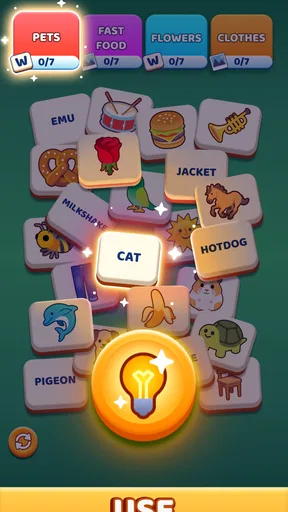
- Helpful hints can prevent difficult levels from becoming frustrating.
- Clean tile-based interface keeps the focus on solving each puzzle.
- Gradually increasing difficulty provides a satisfying sense of progress.
Limitations of Word Association Tiles
- Some answers may feel subjective or unclear without enough context.
- Repeated puzzle patterns can make later sessions feel less varied.
- Hints and assistance may be limited, depending on the level.
- Players seeking fast action may find the gameplay too slow-paced.
- Advanced puzzles can become challenging without offering much guidance.
Similar Picks in This Category
View All
Word Search - Word Puzzle Game
Bluetile4.8

Word Search Quest - Puzzles
Blackout Lab4.8

CodyCross: Crossword Puzzles
Fanatee, Inc.4.7

Words of Wonders: Crossword
Fugo Games4.9

Wordscapes: Word puzzle game
PeopleFun4.7

Word Search Explorer
PlaySimple Games4.9
Frequently Asked Questions
What is Word Association Tiles?
Word Association Tiles is a word puzzle game based on connecting related words and discovering the association between them. Instead of simply forming words from random letters, you need to think about meanings, categories, and familiar connections. Each level presents a tile-based challenge that encourages vocabulary, observation, and logical thinking in short, accessible puzzle sessions.
How do you play Word Association Tiles?
To play, examine the words or tiles shown on the screen and identify which ones belong together. Depending on the level, you may need to create groups, match associated terms, or complete a word relationship. Carefully consider multiple meanings, common phrases, and categories before making a move, because an incorrect selection can make the remaining puzzle more difficult to solve.
Is Word Association Tiles free to download and play?
Word Association Tiles can generally be downloaded without an initial purchase, allowing users to try the core puzzle experience at no cost. However, availability of advertisements, optional hints, extra lives, or other in-app purchases may depend on the version and platform. Before downloading, check the official store listing for current pricing, payment details, and any subscription information.
Does Word Association Tiles require an internet connection?
The game may allow you to complete at least some puzzles offline, which makes it suitable for travel, commuting, or areas with limited connectivity. Nevertheless, an internet connection can be required for advertisements, restoring purchases, updates, cloud features, or certain online content. It is best to open the game once while connected before relying on it offline.
Is Word Association Tiles suitable for children and casual players?
Word Association Tiles is generally appropriate for players who enjoy vocabulary games, brain teasers, and relaxed problem-solving. Its simple tile-based format makes it easy to understand, although later puzzles may require stronger language skills, cultural knowledge, or familiarity with wordplay. Parents should still review the store rating, advertising behavior, and in-app purchase settings before allowing younger children to play.
Play our best games!


